Operation Fuzzy Thunder: What Your Kid's Stuffed Animal Spy Games Reveal About Their Brilliant Little Brain
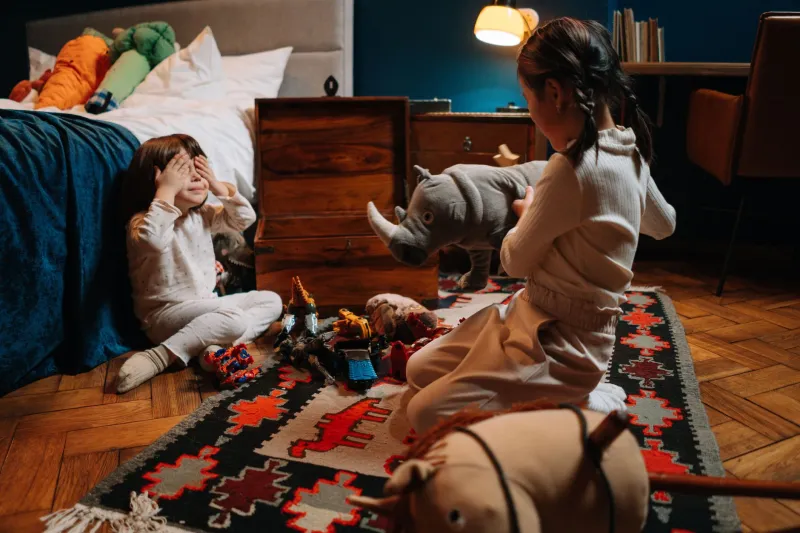
It starts innocently enough. You walk into the playroom and find your seven-year-old crouched behind the couch, whispering into a sock that has been repurposed as a communication device. There's a hand-drawn map on the floor. Stuffed animals are stationed at strategic points around the room. A coded message — written entirely in backwards letters and crayon — is tucked under the coffee table. Your child looks up at you with the intensity of a CIA field operative and hisses: "Mom. You've blown my cover."
Welcome to the world of stuffed animal spy missions. Population: your kid, three plush bears, a rabbit with one ear, and apparently a very sophisticated threat assessment protocol.
If you've witnessed this phenomenon and wondered whether you should be impressed or mildly concerned, let us put your mind at ease: you should be extremely impressed. Because what looks like glorious, magnificent nonsense is actually your child's brain firing on all cylinders in ways that developmental experts genuinely celebrate.
Why Spy? The Psychology Behind the Secret Agent Phase
Children don't randomly decide to turn their stuffed animals into field operatives. There's a developmental logic at work here, and it's surprisingly sophisticated.
Around ages five through nine, kids enter what child psychologists call a period of concrete operational thinking — a stage where they start building mental frameworks for cause and effect, rules, sequences, and systems. Spy play is basically the most entertaining possible workout for all of those skills simultaneously.
Think about everything a spy mission requires: a problem to solve, a plan of action, roles for different characters, a sequence of events, possible obstacles, and some kind of resolution. That's not just play. That's narrative architecture. Your kid is essentially writing, directing, and starring in their own thriller — and their stuffed animals are the ensemble cast.
Dr. Sandra Leanne Bosacki, a researcher who has studied children's imaginative play extensively, has noted that complex role-play scenarios help children develop what's known as "theory of mind" — the ability to understand that other people (or, in this case, plush bears) have their own thoughts, motivations, and perspectives. When your kid assigns a secret identity to Mr. Floppington the rabbit, they're practicing perspective-taking in one of the most organic ways possible.
Coded Messages and the Secret Language of Growing Minds
Here's something that might make you want to frame your kid's incomprehensible backwards-crayon note: creating codes is genuinely hard.
Symbolic thinking — the ability to let one thing stand for another — is a foundational cognitive skill. It's the same mental muscle behind reading, math, and eventually, metaphor. When a child invents a cipher where "Z" means "A" and draws a map where a triangle represents the kitchen, they're exercising symbolic representation in a playful, low-stakes environment.
The fact that they want the code to be unbreakable adds another layer: now they're thinking about audience, about what someone else knows versus what they know, and about how to communicate across that gap. That's a legitimately advanced cognitive task dressed up in a trench coat and tiny sunglasses.
And the plot twists? Don't even get us started on the plot twists. "Wait — it turns out Sergeant Biscuit has been a DOUBLE AGENT this whole time" is your child spontaneously discovering dramatic irony. That's literature class happening on the living room floor.
The Risk-Taking Brain in a Safe Sandbox
Spy games also do something uniquely valuable: they let kids practice risk and consequence without any actual stakes.
In a spy mission, something always goes wrong. The villain escapes. The intel was false. Someone gets captured (usually the stuffed giraffe, who was frankly not cut out for field work). And then your child has to adapt — improvising a new plan, reassigning roles, or completely rethinking the mission parameters.
This is problem-solving under pressure, and it's one of the most important executive function skills a child can develop. The beauty of doing it through play is that failure is funny instead of frightening. If the plan falls apart, nobody's feelings are hurt — except maybe the giraffe's, and he'll recover.
Researchers at the University of Colorado have found that unstructured imaginative play — the kind where kids invent their own rules and scenarios — is directly linked to stronger executive function, better emotional regulation, and higher resilience in the face of real-world challenges. Spy missions are basically executive function boot camp with better costumes.
What the Stuffed Animals Actually Bring to the Operation
Here's where it gets really interesting: the stuffed animals aren't just props. They're doing important developmental work.
When a child assigns a stuffed animal a secret identity — say, the bunny is actually a master of disguise named Agent Velvet — they're practicing something called narrative projection, giving an external object an internal life. This is the same cognitive process that underlies empathy, creative writing, and even collaborative communication.
The stuffed animal also provides what developmental psychologists call a "transitional object" function even in play contexts. It's a safe anchor. The child can take narrative risks — introducing danger, conflict, betrayal — precisely because the stuffed animal will always be okay. It's a way of exploring big, sometimes scary concepts (danger, deception, loyalty, courage) from behind the protective cushion of a fluffy bear.
In other words: your kid isn't just playing spy. They're using play to safely rehearse emotional complexity. That's not nothing. That's actually kind of extraordinary.
How to Be the Best Handler Your Little Agent Ever Had
So how do you encourage this kind of play without accidentally ruining it by being too helpful (we see you, parents who try to optimize the spy mission)? A few ideas from JoeJoe Bear HQ:
Stock the supply room. Keep a box of "spy supplies" accessible — blank index cards for coded messages, a magnifying glass, some colored tape for marking off zones, maybe a small notebook. You don't need to build anything. Just make the raw materials available and let them do the rest.
Introduce a mystery. Leave a sealed envelope somewhere unexpected — on the kitchen table, tucked under a couch cushion — with a note that says something cryptic like "The snack has been moved. Find it before 3 PM." Then watch the operation unfold. (Yes, this means you have to hide the snack. Worth it.)
Ask for a debrief, not a spoiler. Instead of asking "What are you playing?" (which can break the spell), try asking afterward, "How did the mission go? Did everyone make it back?" This invites storytelling and reflection without interrupting the flow.
Let the mission fail sometimes. If your kid asks you to play the villain, play the villain well. Let them experience the problem-solving challenge of things not going according to plan. The recovery is where all the good brain stuff happens.
Create a Hall of Fame. Keep one or two of those coded messages or hand-drawn maps. Tuck them away. Years from now, when your kid is in middle school and far too cool for spy missions, you'll both want to remember the summer they ran a covert intelligence operation out of the den with a stuffed bear named Colonel Biscotti.
The Takeaway from the Field
The next time you find yourself accidentally blowing an undercover operation in your own living room, take a moment before apologizing to your tiny field commander. Because what you're actually interrupting is a live demonstration of narrative thinking, symbolic reasoning, perspective-taking, creative risk assessment, and emotional exploration — all happening simultaneously, all self-directed, and all powered by nothing more than imagination and a slightly threadbare stuffed animal with a classified identity.
That's not just cute. That's cognitive development in action.
Now please, for the love of all things fluffy: step away from the mission perimeter. Colonel Biscotti is counting on you.